
Custom Stainless Steel Jewelry: PVD Plating and Minimums
PVD is a vacuum process, not a plating bath, and that single difference shapes how a stainless order is built. A thin film is deposited onto the part inside a chamber, the published stainless floor is 100+ pieces per design, and 316L — with 2–3% molybdenum — is the grade the manufacturer says takes PVD best.

Key takeaways
- 316L contains 2–3% molybdenum and is published as shower-safe and swim-proof when PVD coated.
- The stainless threshold is 100+ pieces per design, twice the 50-piece silver floor.
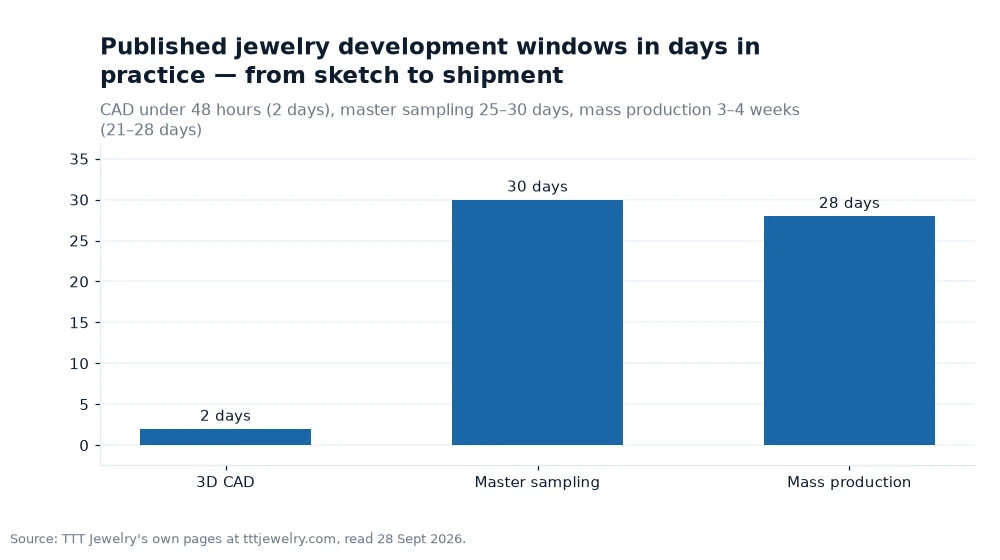
- CAD takes under 48 hours, sampling 25–30 days, and mass production 21–28 days.
- Final QC inspects 100% of pieces, so a 200-piece two-colour run yields 200 inspections.
PVD on stainless, and the grade that takes it best
Physical vapour deposition happens in a vacuum chamber. A source material is vaporised, and the vapour condenses onto the part as a thin film. Because the film arrives atom by atom rather than growing out of a chemical bath, it can be applied to alloys that would not accept a conventional electroplated layer well. The published note is that 316L takes PVD best.
The film is thin, so it does not hide the surface underneath. A mirror-polished blank stays mirror-bright after coating; a brushed blank keeps its directional grain. Surface preparation therefore happens before the chamber, not after it, and a scratch that reaches the substrate will still read through the coating.
Coverage depends on how the part is held. Flat faces coat evenly; deep recesses and the inside of a curve need rotation or a second pass. That is a fixturing question, and it is one reason a new shape starts with a sample rather than a bulk run.
PVD also changes wear behaviour. The coating is harder than the base metal and resists the abrasion that dulls a polished stainless surface in daily wear. It is not a paint and it does not chip like one, but it can be worn through by repeated metal-on-metal contact, which matters at a clasp or a hinge.
The published material notes separate the two grades by purpose. 316L contains 2–3% molybdenum, is waterproof and published as shower-safe and swim-proof, and is described as medical-grade hypoallergenic. 304 is water-resistant for daily wear, nickel and lead safe, and vacuum-plated for cost-effective volume.
The molybdenum is the technical difference. It improves resistance to chlorides, which is why 316L is the grade associated with pool water and seawater exposure rather than splashes. A 304 piece is a reasonable choice for a fashion range that stays out of the water; a 316L piece is the choice when the product claim is waterproof.
Both grades are finished by PVD, so the visual result can look identical on the shelf. The difference appears in the wear test and in the care instructions, not in the colour card.
| Grade | Published note | Water exposure | Finish route | Order fit |
|---|---|---|---|---|
| 316L | 2–3% molybdenum, medical-grade hypoallergenic | Shower-safe and swim-proof | PVD vacuum plating | Waterproof claims, higher retail price points |
| 304 | Nickel and lead safe | Water-resistant for daily wear | Vacuum plating | Cost-effective volume, fashion ranges |
Neither row is a rank order. A brand selling into a humid climate may prefer 316L across the range even where the piece is not marketed as waterproof, because the care message stays consistent. A brand chasing volume in a dry market can build on 304 and keep the claim modest.
Why the floor sits at 100+ pieces
The stainless steel MOQ is published as 100+ pieces per design. The number is a floor per design, not per order, and it is twice the silver minimum of 50. Three mechanisms explain the gap.
The first is fixturing. Each shape needs a jig or a rack position so it can be coated evenly, and that setup is repeated for every design in the run. The second is chamber load: a vacuum cycle has a working volume, and a small batch uses the same pump-down time as a full one. The third is colour change, since switching the source material between colours means cleaning the chamber and re-establishing the process.
A brand ordering 100 pieces of one design pays the setup once. A brand ordering 25 pieces across four designs pays it four times and still runs four chambers. The published threshold is a way of keeping the per-piece share of that fixed work within a sensible band, not an arbitrary rule.
For a wholesale stainless steel jewelry factory, the floor is also a scheduling rule: a chamber run is planned around a batch, so the batch has to be worth a cycle. That is why the number is quoted per design and why late colour additions reopen it.
For a buyer comparing materials, the arithmetic is simple: 50 silver pieces equal 50% of the 100-piece brass minimum, and the stainless floor matches brass at 100+. Design count is the multiplier. Ten stainless designs at the minimum is 1,000 pieces before a single reorder.
Writing a PVD spec that survives the chamber
A coating spec needs five lines: the grade, the colour, the substrate finish, the areas that must stay bare, and the parts that move. Each one changes what the chamber sees.
Grade and substrate finish are linked. A 316L blank polished to a mirror and a 316L blank brushed to a satin both take a gold-tone film, but they reflect differently, and the same colour name will not produce the same look. State the substrate finish, not only the colour.
Areas that must stay bare are usually functional: a thread, a spring, a hinge pin, or a face that will be laser-engraved with the 316L mark afterwards. Those areas are masked before coating. A two-tone design, where a brushed panel sits beside a coated one, needs masking in the chamber and often a second polishing pass afterwards.
Moving parts deserve their own note. A clasp that opens and closes hundreds of times will wear at the contact point, and a thin film there can polish away. The practical answer is to specify the coating on the visible body and accept bare stainless at the working surfaces, or to choose a design that keeps the mechanism out of sight.
Compliance travels with the finish. Plating is published as 100% compliant with REACH and CA Prop 65, which covers the coating chemistry as well as the substrate, and ISO 9001:2015 is the framework behind batch records. A PVD order that will be sold in the EU should carry that statement in the technical file.
Where the calendar goes
Development follows the published sequence: CAD under 48 hours, a master sample in 25–30 days, then mass production in 21–28 days. For a stainless piece, the sample is also the first real test of the coating, because colour and coverage are judged on a physical part.
A first sample usually answers shape questions; a coating change answers colour questions. If both are in play at once, the second round is the one that settles the finish. That is why the spec sheet should be complete before the CAD is released, not after the sample arrives.
Reading the route as a whole: 2 days of CAD plus 25–30 days of sampling plus 21–28 days of production gives 48–60 days, or roughly seven to nine weeks, from brief to shipment. Anything that adds a sampling round adds 25–30 days to that figure.
Worked example
A brand wants one design in two PVD colours. At the 100+ floor, that is 2 × 100 = 200 pieces, and final QC inspects all 200 rather than a sample. Add a third colour and the commitment becomes 300 pieces, with 300 inspections.
Now spread a fixed setup cost S across the run. At 100 pieces the per-piece share is S/100. At 300 pieces it is S/300, one third of the figure. The chamber time per cycle has not changed; only the number of pieces sharing it has.
The development calendar is smaller than the order calendar. CAD at 48 hours is 2 days, which is 2 ÷ 30 = 6.7% of a 30-day sampling round, or 2 ÷ 25 = 8% of a 25-day one. The sampling stage dominates early timing, and the production stage dominates late timing.
A brand testing two grades can halve the sample count by putting 316L and 304 in the same review, since the shape is shared and only the substrate differs. The custom brass jewelry line is a useful third comparison at that stage, because brass sits between silver and stainless on cost and takes a different plating route.
Frequently asked questions
Is PVD the same as gold plating?
No. PVD deposits a thin film in a vacuum chamber, while gold plating on silver or brass is an electrolytic process, so the same colour name describes two different routes.
Can a PVD-coated 316L piece be worn in the pool?
The published note describes 316L with PVD as shower-safe and swim-proof, and rinsing the piece in fresh water after exposure helps remove chlorine and salt from the surface.
Why is the stainless minimum higher than the silver minimum?
The published stainless floor is 100+ pieces per design against 50 for silver, because chamber load, fixturing and colour changes are shared across the batch.
Planning a mixed-material range
Most brands do not choose one material for everything. They put the waterproof claim on 316L, the volume price point on 304, and the stone-led pieces in silver. The shared constraint is the finishing route, since a gold tone on stainless and a gold tone on silver are produced by different methods.
Ordering the materials together helps only if the colours are approved together. The sterling silver jewelry manufacturer route runs on a 50-piece floor, so a small silver capsule can sit beside a larger stainless run without the same tooling exposure.
Write the grade, the colour, the substrate finish and the masking into one spec, then approve it on a physical sample. The chamber will reproduce what the spec describes, including any gap left in it.
Source note: figures come from the manufacturer's own website (tttjewelry.com), read 28 Sept 2026.[1]